Modern applications demand high availability, zero downtime, and predictable behavior during deployments. Kubernetes gives us powerful primitives to achieve this—but only if they are configured correctly. Poor rollout strategies can easily negate the benefits Kubernetes promises.
In this article, we’ll walk through common rollout problems in Kubernetes and explore proven configuration strategies that help ensure reliable, highly available deployments in production environments.
What Is Kubernetes?
Kubernetes is a container orchestration system designed to deploy, manage, and scale containerized applications efficiently. It abstracts away infrastructure complexity while providing robust mechanisms for scaling, healing, and updating applications.
A simple Kubernetes deployment looks like this:
apiVersion: apps/v1
kind: Deployment
metadata:
  name: myapp
spec:
  selector:
    matchLabels:
      app: nginx
  replicas: 1
  template:
    metadata:
      labels:
        app: nginx
    spec:
      containers:
      - name: nginx
        image: nginx:1.14.1
        ports:
        - containerPort: 80
While this works, it is far from production-ready when it comes to availability and safe rollouts.
Common Ineffective Rollout Problems
Many Kubernetes issues don’t come from the platform itself, but from incomplete or unsafe deployment configurations. Common problems include:
- Downtime during deployments
- Improper resource allocation
- Service outages during pod restarts or failover
- Uneven pod distribution across nodes
- No internal health checks
- Abrupt pod termination
Left unresolved, these issues can lead to unreliable services and poor user experience.
Effective Rollout Strategies in Kubernetes
1. Use Multiple Replicas with Rolling Updates
Running a single replica is risky. A safer approach is to use multiple replicas combined with rolling updates to ensure traffic is always served during deployments.
replicas: 3
strategy:
  type: RollingUpdate
  rollingUpdate:
    maxSurge: 1
    maxUnavailable: 0
This ensures:
- New pods are created before old ones are removed
- Zero downtime during updates
2. Proper Resource Allocation and Quotas
Without resource requests and limits, Kubernetes cannot make intelligent scheduling decisions.
resources:
  requests:
    memory: "64Mi"
    cpu: "250m"
  limits:
    memory: "128Mi"
To protect the cluster as a whole, apply ResourceQuotas at the namespace level:
apiVersion: v1
kind: ResourceQuota
metadata:
  name: example-resource-quota
spec:
  hard:
    requests.cpu: "1"
    requests.memory: 1Gi
    limits.cpu: "2"
    limits.memory: 2Gi
This prevents a single workload from exhausting shared resources.
3. Evenly Distribute Pods Across Nodes
Pod concentration on a single node increases the blast radius during failures. Pod anti-affinity ensures pods are spread across nodes:
affinity:
  podAntiAffinity:
    requiredDuringSchedulingIgnoredDuringExecution:
    - labelSelector:
        matchExpressions:
        - key: app
          operator: In
          values:
          - web-store
      topologyKey: "kubernetes.io/hostname"
This improves resilience and fault tolerance.
4. Health Checks with Probes
Kubernetes probes allow the platform to detect unhealthy containers and react automatically.
- Readiness Probe – Controls traffic routing
- Liveness Probe – Restarts unhealthy containers
- Startup Probe – Handles slow-starting applications
readinessProbe:
  httpGet:
    path: /health
    port: 80
  initialDelaySeconds: 5
  periodSeconds: 10
Using probes correctly ensures only healthy pods receive traffic.
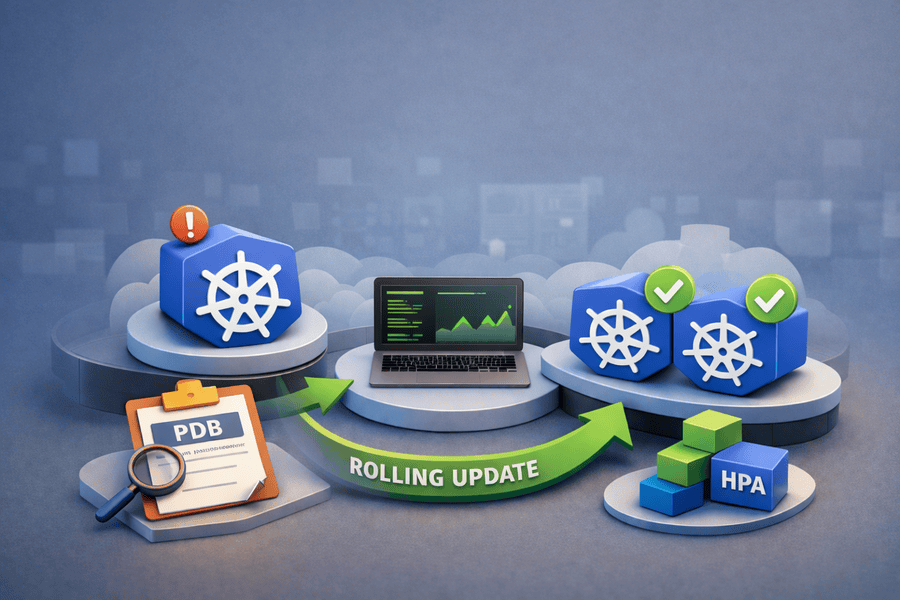
5. PodDisruptionBudget, HPA, and Graceful Termination
PodDisruptionBudget (PDB) protects availability during voluntary disruptions:
apiVersion: policy/v1beta1
kind: PodDisruptionBudget
spec:
  minAvailable: 2
Horizontal Pod Autoscaler (HPA) scales workloads based on demand:
minReplicas: 2
maxReplicas: 5
targetAverageUtilization: 50
Finally, graceful termination allows pods to finish in-flight requests:
terminationGracePeriodSeconds: 60
Together, these configurations make your applications more resilient and production-safe.
Final Thoughts
Kubernetes provides all the tools needed for safe and effective rollouts—but defaults are not enough. High availability, zero downtime, and predictable deployments require intentional configuration.
By combining rolling updates, proper resource management, health checks, pod distribution, and autoscaling, you can confidently run production workloads that behave well even under failure or change.